My
Spiritual Bastogne
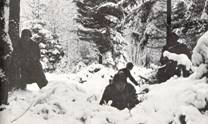
“The front lines of our allies were only 5 miles away, separated from our army by 5 miles of what we were beginning to call hell-on-earth, no-man’s land. It wasn’t really no-man’s land, it was occupied by the enemy, these gray-uniformed soldiers with superior armour, deadly accurate antitank guns, field howitzers, machine gun emplacements and mortar pits. The front lines of our allies and our own front lines came to within five miles of each other at this little town our platoon was facing, which naturally the enemy was occupying and had heavily fortified with howitzers and anti-tank 88’s. We were entrenched, a small platoon of us, in our foxholes in a forest overlooking this town, with an open snow-covered field between us and the town. It was cloudy and always lightly snowing, and was also bitter cold. The winter’s snow was only ankle deep in the forest, but the enemy knew exactly where we were dug in. They had repeatedly shelled the forest with deadly accuracy, many trees had been blown to bits, their stumps standing six to eight feet off the ground where incoming 88-rounds had struck, blowing them in half. Other rounds hit the snow-covered ground blowing the snow away from the shallow depressions their detonations made, leaving dark earthen circles twenty feet in diameter. As long as we were in a foxhole during an enemy barrage we were relatively safe, unless an unlucky round landed in our foxhole. The enemy had superior weapons, winter clothing, an almost unlimited supply of food and ammunition, and he was well-entrenched.
The two armies he was holding apart were from two different countries, speaking two different languages. We were allies, fully united in purpose and objective, but there was almost no coordination (and little or no cooperation at all) between the two allied armies. It was like this pride thing of who was better existed between us, which made the enemy’s job far easier for him--keeping our two armies apart.
Who were we, anyway? We were paratroopers, a specialized forward element Platoon made up of specially selected well-trained bi-lingual paratroopers who could speak the language of both armies, as well as being well versed in each army’s cultural background. We were a scout unit, designed to hold the lines and gather intelligence--but we didn’t possess the manpower or firepower to mount an offensive on our own, it just wasn’t our job, until major re-enforcement’s arrived. And when that time came, and more importantly, when a significant number of re-enforcement’s came, then it might be our job to help spearhead the invasion of the town that would link our two armies. So our overall objective, eventually, was to take out the enemy in the town holding our two armies apart, thus breaching no-man’s land, bridging the gap, and bringing a degree of cooperation and flow of vital supplies to whichever army needed them most--establishing a sharing of resources, manpower and vital intelligence.
But the enemy was in a strategic location, holding this town. We had limited ammunition, each soldier often with only one spare clip for his M1. We were in no position to overrun the enemy or mount any kind of offensive without first getting some serious numeric superiority. We’d be slaughtered if we advance into the town. But remaining here was getting to be extremely demoralizing. Bitterly cold weather, dwindling rations of food (whenever you lighted a fire to heat it up a little or to get warm, you almost always had an 88 round come straight in and hit the fire, injuring or killing those foolhardy enough to light it and sit near it)--and worst yet, there were no replacements, and especially no re-enforcement’s so we could advance, get it over with, and thus get out of this hell-hole.
When an artillery barrage took place at dusk or at night it was a brilliantly stunning display of deadly fireworks--bright orange and yellow flashes, balls of fire the size of a small house, accompanied by a deafening roar. During a barrage this was repeated many times over, sometimes a number of them going off almost simultaneously, the detonations sort of walking through the forest between our foxholes. Anyone caught outside his foxhole was “dead meat” or got seriously wounded. So we couldn’t walk around during all this, just had to stay ‘hunkered down’ shivering in our cold foxholes while the display of fireworks went off over our heads. It was better than twenty 4th of July’s all going off in your backyard at once. Our real objective was to hold the line, watching for enemy weaknesses, occasionally probing for their weak points, but overall, holding the line until serious re-enforcement’s and re-supply came our way. Then we could mount an offensive against the town and bridge the gap between our two armies. But then, I’m repeating myself. Must be the cold, coupled to all the other crap coming our way without ceasing. It was the isolation that got to you, stuck in your own foxhole, one guy, all alone--cold, hungry, and even worse, no com-lines running between foxholes--just total isolation. Our platoon was spread out over too large an area, and without laying out field-phone lines between our foxhole emplacements, we often lacked the coordination to respond properly when the enemy would probe our lines with a platoon of their own, often directly following a barrage, sneaking up to our lines as a barrage was going off. If this wasn’t bad enough, at this point, with the mixed nature of some of the members of our platoon--some from one country, some from the other--it often led to the inevitable friction between soldiers (minor stuff, but irritating nonetheless). Yeah, we were all bilingual, but some of us didn’t share the heritage or common background of the guy next to us. So there was this kind of disconnect that existed even between you and the guy in the next foxhole. This contributed to the loneliness and knawing feeling of isolation--like you just didn’t fit anywhere. It wasn’t a good situation at all.
We really needed something like a whole division or two coming up alongside our side of the lines we were holding down (and we needed them all bilingual, composed of a specialized bilingual Corps, just as we were!). But that would be asking too much, now, wouldn’t it? In our specific area, we would need no less than three companies at full strength, armour included (145 to 160 men each), being thrown into the front with us. Then we could start to prepare for mounting a reasonable offensive, with a good chance of breaking through and taking the town once the offensive was engaged. And finally with that accomplished, linking forward elements of the two armies . Then those two divisions could unite the two armies up and down the whole breach in our lines, separating the two armies. (It’s gonna be interesting to see how the “Big Brass” from each side hammer out some kind of working battle strategy toward winning the war, once the two armies are united. I’d love to be a fly on the wall in that CP hut! But grunts like us don’t ever get that kind of opportunity. Best anyway to stay clear of brass like that if at all possible.)
As
I said before, but it bears repeating, sometimes during a barrage the
enemy would send an advance unit toward our lines, probing
for an opening. As they got
close, especially if it was at night, we could see their eyes, glowing red.”
Who
are we? Maybe I can best answer that question
by defining what two nationalities made up our two allied armies. For we were specifically selected
from a uniquely trained paratrooper unit from a bilingual nationality
that was a cultural cross-culture of both armies, as I said before. And some of us are also from the two separate
armies. One army is made
up of the Gentile branch of the body of Christ, the Gentile Christian
church. The other army is made up of the Jewish
branch of the body of Christ, what many are now calling Messianic Jewish
believers. Our specific
military task is to accomplish the proclamation of the gospel to all
peoples of the world, as our Commander in Chief commanded us just before
he ascended to heaven (cf. Matthew 28:18-20; Acts 1:6-9; Matthew 24:14). The
enemy is Satan and his demons, who have been actively opposing this
spiritual military effort with a fierce spiritual military effort of
their own. One of our most
famous early commanding major-generals, the apostle Paul described
this spiritual warfare in Ephesians 6:11-19. But
verse 12 describes the enemy, “For we wrestle not against flesh
and blood, but against principalities, against powers, against rulers
of the darkness of the world, against wicked spirits in high places.” What
was his spiritual military advice? Next
verse, “Wherefore take unto you the whole armour of God, that
ye may be able to withstand the evil day, and having done all, to stand.” He goes on in verses 14-19 to describe
the armour of his day. But
I have transposed the armour into the somewhat modern setting of an
actual battle that took place in Foy, near Bastogne altering it a bit
to fit the situation I and a few other believers find themselves in
as we struggle to “connect the two armies” we hail from
together in a tactical manner. What
is particularly demoralizing is that the two “armies” we’re
attempting to bridge a gap to are extremely suspicious of each other
and in some cases, outright hostile to each other. They
don’t even want to learn the foundational information of how
the other operates, and they each view the culture of the other with
suspicion.
Our
special military assignment, given to us from the very top, is even more
demoralizing and unpleasant. Why? Because the attitudes we most often encounter
from lower ranking officers outside our own particular specialized platoon
view us as total outsiders--not belonging to either of the two allied
armies. Both sides are suspicious of us
and our special job, so neither side wants to supply us, let alone give
us any recognition that we even exist. Just
makes a soldier want to throw his rifle down, climb out of his foxhole
and start walking away from the line and blend back in with the normal
army he came from. What we
need is re-enforcements at Division to Corps strength, from that unique
bi-cultural-bilingual army that shares the cultures of both armies. But
that “army” is still in its formative stage and infancy stage,
with recruitments and enlistments lagging behind, which is slowing efforts
to get unified basic training done. We
may not see this bi-cultural “army” for months to even years
from now. So holding out is the main concern.
Just thought some of you guys might like to see a military analogy of what we’re all up to, and especially, what we’re up against. And by “we” I mean all that are involved in attempting to bring spiritual unity and understanding between the Gentile and Jewish branches of the body of Christ. The apostle Paul never hesitated to put our spiritual battle into the military analogies of his day (cf. Ephesians 6:11-19, Roman soldier’s battle-field equipment). Want to see where I got this analogy? Locate the “Band of Brothers” series, and find tape three and four. The names of the series are “Bastogne” and “The Breaking Point—Battle of Foy”. In the series, “Bastogne” is on tape three (second movie) and “The Breaking Point” is on tape four (each tape in the series has two one hour movies). The series is the entire history of Easy Company from their early paratrooper training in the states, all the way through Europe to Hitler’s Eagles Nest. These were ordinary men, yet at the same time phenomenal soldiers. If we can even partly emulate them spiritually in battle, we’ll all do the enemy a world of hurt, and go a long way toward accomplishing the goal Yeshua has given us to do. Just thought you guys might find this an interesting way of looking at what we’re up against, looking at it from a different perspective. It might help us do our jobs better by helping to give some vision and focus, a sort of reason for being for our particular church culture. And what might that “church culture” be, you ask? It is non-Torah observant Sabbatarian Church of God. This church denomination, above and beyond all others, is a perfect bi-cultural/bi-lingual cross-connect between the two “allied armies.”
